Wednesday, 11 February 2015

Tuesday, 10 February 2015
(GROUP POST) Evaluation Question 3 - What have you learnt from your audience feedback?
Throughout our project, Becka and I presented our target audience with many forms of surveys in order to get all the information we would possibly need to meet our target audiences expectations. During research & planning we conducted a paper survey which helped us understand the main basis of what our target audience wanted from a music video. These were our results:
Initial Target Audience Research
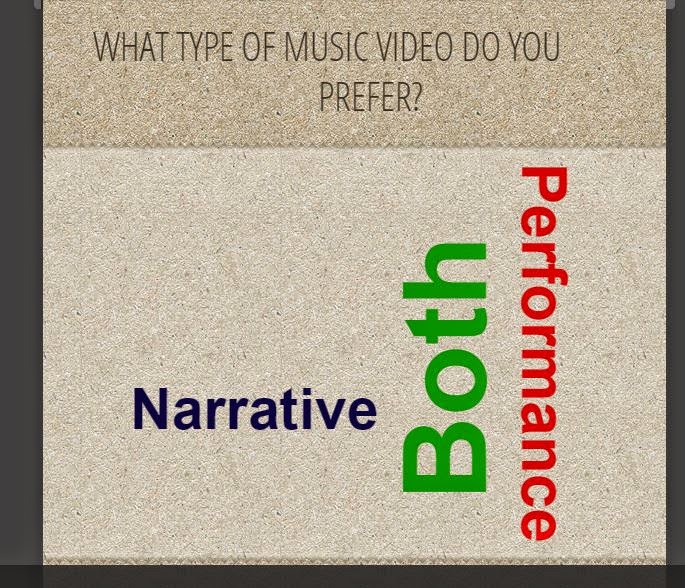
Becka and I distributed 20 surveys to people aged 12 - 30 to get a wide range of feedback on what young and older people want from a music video. Although we are mainly aiming our video at older teens/young adults, we were interested to see why people of other ages watch music videos and what they like to see. The feedback from our survey is on an 'infogram' presentation.
The results were:


From our initial research we successfully found out what our audience wanted from our music video so this enabled us to decide what conventions to develop and challenge. If we were to do this task again, we would definitely conduct a paper survey again because it was very effective and we received a wide range of feedback.
According to McDougall's (2009) audience theory, he suggests that the online age is getting harder to identify and argues that an audience is 'just a hypothetical group of people, imagined for the sole purpose of having a target for a media product'. This theory proposes that our audience feedback isn't very significant and will not necessarily advise us on how to improve our music video.
We conducted a focus group in the early stages of editing whereby a group of people aged 16 and 17 watched our first rough cut of our music video and gave feedback. We received mixed responses and this is what a few people said:
Male, 16 - "I like the different shots and colours but not sure what the concept is."
Female, 17 - "I like the way the shots have been put together with transitions but I'm not keen on the inserts because they look too sharp. Also, I like how the video is similar to a story too."
Female, 16 -"I really like the concept of the music video and I like the scenery shots of the trees and lake, so it would be nice to see more of this."
Male 16 - "The piano shots look good because it shows the instruments and I like the nature feel to the video of the lake and trees."
Male 17 - "Overall I liked the music video because of the combination of performance and narrative shots but I don't like the curtain background because it makes it look less professional."
Our results showed that the majority of female viewers understood the 'love' and 'relationships' concept of our video although some of the males didn't. From this, we decided to add more narrative shots of the children with their parents and Becky with Will, this was so there was more of a story line to follow and it was more understandable. Something that was mentioned by more than one person was the backdrop on the performance shots. This was something that Becka and I found very difficult to hide and no matter how many filters or colour masks we put onto it, it just didn't look any better. However, boosting the contrast and brightness did help along with the black and white effect. We added a few inserts onto some of our shots which acted as flashbacks but one person said they looked too sharp and someone else said they didn't understand why they were there. To resolve these issues we removed most of the inserts but kept one or two and changed the outline so it was softer. Also, we used Goodwin's theory by showing a relationship between lyrics and visuals so that it was easier for the audience to understand.
Some of our target audience really liked the shots of the lake and the trees and didn't feel there was enough of these type of shots, so we decided to incorporate more into our video. We didn't want to remove any of the other existing performance or narrative shots so we changed the opacity to layer two shots together. Overall, we received positive reviews with a little criticism which we took into consideration and helped us to make changes to meet our target audience demands.


We also conducted another focus group interview when our music video was finished. The group responses varied.
1) All people understood the concept.
2) Most people thought our shots and star image worked well with the genre.
3) Our audience enjoyed our lake shots and understood the concept.
4) All people thought our shots looked professional.
5) However, some people said our shots could have been focused better.
Becka and I also posted our Music Video on YouTube to get feedback however no one commented a response to our video therefore, on reflection we could see that this didn't help us in any way. Also, from this we have learnt that if we were to conduct this research again, we wouldn't rely on YouTube for feedback and possibly use a social network such as Facebook or Twitter.
Initial Target Audience Research
Becka and I distributed 20 surveys to people aged 12 - 30 to get a wide range of feedback on what young and older people want from a music video. Although we are mainly aiming our video at older teens/young adults, we were interested to see why people of other ages watch music videos and what they like to see. The feedback from our survey is on an 'infogram' presentation.
The results were:
- All of our TA wanted to see 50% performance shots with the stars looking into camera and 50% narrative shots. We believe that we did manage to differentiate the shots well and incorporate both in our music video.
- 50% of our initial audience wanted to see our video filmed at an outside location and the other 50% wanted to see an inside location, such as a studio. We think that we used an appropriate amount of both inside and outside locations, which suited our genre accordantly.
- We asked our audience if they like to get a feeling from the video, 13 people said no, therefore Becka and I didn't feel pressured to create a certain mood or atmosphere.
- Our TA results showed that they are mostly attracted to a music video because of the artist and the song so when we created our promotional package we took this into consideration.
- The majority of our audience said that they would like to see a change in colour of shots. We think that we did this successfully because we decided to use black and white for performance shots and sepia/colour shots for our narrative.
From our initial research we successfully found out what our audience wanted from our music video so this enabled us to decide what conventions to develop and challenge. If we were to do this task again, we would definitely conduct a paper survey again because it was very effective and we received a wide range of feedback.
According to McDougall's (2009) audience theory, he suggests that the online age is getting harder to identify and argues that an audience is 'just a hypothetical group of people, imagined for the sole purpose of having a target for a media product'. This theory proposes that our audience feedback isn't very significant and will not necessarily advise us on how to improve our music video.
We conducted a focus group in the early stages of editing whereby a group of people aged 16 and 17 watched our first rough cut of our music video and gave feedback. We received mixed responses and this is what a few people said:
Male, 16 - "I like the different shots and colours but not sure what the concept is."
Female, 17 - "I like the way the shots have been put together with transitions but I'm not keen on the inserts because they look too sharp. Also, I like how the video is similar to a story too."
Female, 16 -"I really like the concept of the music video and I like the scenery shots of the trees and lake, so it would be nice to see more of this."
Male 16 - "The piano shots look good because it shows the instruments and I like the nature feel to the video of the lake and trees."
Male 17 - "Overall I liked the music video because of the combination of performance and narrative shots but I don't like the curtain background because it makes it look less professional."
Our results showed that the majority of female viewers understood the 'love' and 'relationships' concept of our video although some of the males didn't. From this, we decided to add more narrative shots of the children with their parents and Becky with Will, this was so there was more of a story line to follow and it was more understandable. Something that was mentioned by more than one person was the backdrop on the performance shots. This was something that Becka and I found very difficult to hide and no matter how many filters or colour masks we put onto it, it just didn't look any better. However, boosting the contrast and brightness did help along with the black and white effect. We added a few inserts onto some of our shots which acted as flashbacks but one person said they looked too sharp and someone else said they didn't understand why they were there. To resolve these issues we removed most of the inserts but kept one or two and changed the outline so it was softer. Also, we used Goodwin's theory by showing a relationship between lyrics and visuals so that it was easier for the audience to understand.
Some of our target audience really liked the shots of the lake and the trees and didn't feel there was enough of these type of shots, so we decided to incorporate more into our video. We didn't want to remove any of the other existing performance or narrative shots so we changed the opacity to layer two shots together. Overall, we received positive reviews with a little criticism which we took into consideration and helped us to make changes to meet our target audience demands.
This is an example of how we added more scenery by changing the opacity of 2 different shots.
This is an example of how we changed the colour of shots and upped the brightness and contrast to discuise the curtain background.
We also conducted another focus group interview when our music video was finished. The group responses varied.
1) All people understood the concept.
2) Most people thought our shots and star image worked well with the genre.
3) Our audience enjoyed our lake shots and understood the concept.
4) All people thought our shots looked professional.
5) However, some people said our shots could have been focused better.
Becka and I also posted our Music Video on YouTube to get feedback however no one commented a response to our video therefore, on reflection we could see that this didn't help us in any way. Also, from this we have learnt that if we were to conduct this research again, we wouldn't rely on YouTube for feedback and possibly use a social network such as Facebook or Twitter.
Tuesday, 20 January 2015
(GROUP POST) Evaluation Question 4 - How did you use media technologies in the construction and research, planning and evaluation stages?
Before we started planning and filming our music video we created a blog on 'Blogger' to enable us to continuously update our journey through the making of our music video. We used the blog in our AS course and also in our A2 course. We used the blog to write posts about everything from our choice of music genre, our research and our preferred filming locations. This is a technology which we had previously used in our AS media project so we were well aware on how to use it but this year we became more aware on how to organise our posts so it showed a continuous journey and learnt new skills such as how to embed a video.

Last year we used 'Prezi' for certain posts in our course, such as, target audience research analysis, this year however, we didn't use it. We find 'Prezi' quite difficult to use and prefer to use other technologies such as 'Infogram'. We also created a few powerpoints on Microsoft and uploaded them onto 'Slideshare'.


When we produced our risk assessments, call sheets and child permission forms, we used Microsoft Word. We are both very familiar with this programme as we have used it many times before in AS, A2 subjects and wider uses, which made things easier to produce.

This year we used Final Cut Pro X to create our Music Video. At the beginning of this years course, we create a short documentary about sixth form to help us get used to the program. From the first documentary we constructed, we learnt how to upload footage from our cameras and import shots on to the timeline and cut them. We became competent in using transitions and filters on specific shots, which helped us to create a professional looking music video.

Overall we used several technologies to help use create and publish aspects in this year's course. I think without using certain technologies the task would haven proven difficult.
This year we used Final Cut Pro X to create our Music Video. At the beginning of this years course, we create a short documentary about sixth form to help us get used to the program. From the first documentary we constructed, we learnt how to upload footage from our cameras and import shots on to the timeline and cut them. We became competent in using transitions and filters on specific shots, which helped us to create a professional looking music video.
Overall we used several technologies to help use create and publish aspects in this year's course. I think without using certain technologies the task would haven proven difficult.
Monday, 19 January 2015
(GROUP POST) Final Adverts.
These is our final adverts, one to promote the album and one to promote a tour. We decided to use the outdoor theme with the trees as well as stills from our music video because it creates synergy between all of our promotional package and music video.


(GROUP POST) Final Digipak.
This is our final digipak. We have continued to use black and white and sepia colours like in our music video to create synergy along with the theme of the lake and trees which will make it more recognisable for our target audience.

Sunday, 18 January 2015
(GROUP POST) - Our Merchandise.
This is some merchandise we have designed which could be part of our bands promotional package. From research with existing artists we found that merchandise is popular. Fans are drawn to designs that are easily recognisable with the artists they like so it is important to keep a common theme. Here we have created synergy through through the designs because of the feather and tree theme linking back to our music video and digipak. If the merchandise is a success, there is a potential for high sales and the artists becoming more well known.


Subscribe to:
Posts (Atom)